For most of the internet's history, getting a website meant hiring someone to build it for you.
You called an agency, briefed a freelancer, or asked a developer friend. You explained what your business did, what you wanted the site to look like, and what it needed to do. Then you waited. They translated your words into wireframes, mockups, code, and CMS templates. You reviewed. You sent feedback. They revised. Weeks passed. Money was spent. Eventually a site went live, and every change after that meant another email, another ticket, another invoice.
That whole loop is no longer necessary for most small business websites.
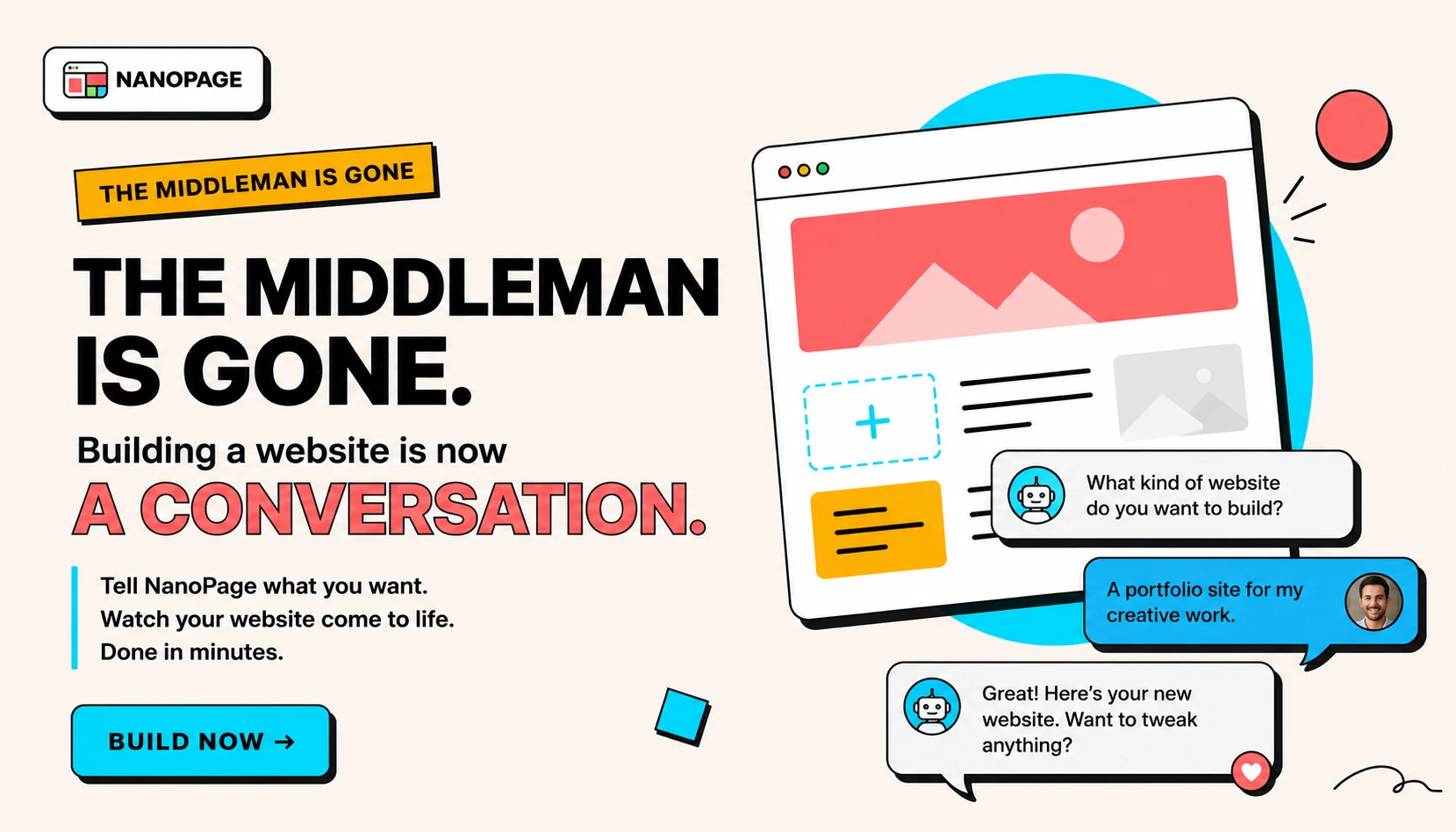
You can now describe what you want in plain language, attach the files you already have, and get a real, hosted website back. No agency in the middle. No developer to interpret your brief. No translation layer between your idea and the page.
This is a structural change, not a feature change. It is worth understanding what actually shifted.
The old loop
Before AI, the website-building chain looked roughly like this:
- Owner has an idea.
- Owner calls an agency or freelancer.
- Agency runs a discovery call.
- Agency writes a scope and quote.
- Owner approves and pays a deposit.
- Agency drafts wireframes.
- Owner reviews wireframes.
- Agency designs mockups.
- Owner reviews mockups.
- Agency builds the site in a CMS or a custom stack.
- Owner reviews staging.
- Agency launches.
- Owner needs a change. Back to email.
Every step added time, cost, and translation loss. The agency never knew the business as well as the owner. The owner never knew the tooling as well as the agency. The site that shipped was a compromise between what the owner could explain and what the agency could interpret.
That loop made sense when websites required HTML, hosting setup, design tools, and code. It does not make sense for a one-page business site in 2026.
What actually changed
Three things changed at once.
First, AI got good enough to read a messy brief, a PDF, a pile of phone photos, and a few sentences of intent, and produce a sensible, structured website from them.
Second, hosting, domains, and SSL got cheap and automatic. You no longer need a sysadmin to put a page on the internet.
Third, the cost of generating the first version dropped to roughly the cost of one prompt. There is no longer a meaningful penalty for trying a version, throwing it away, and trying again.
The combination matters. AI alone is a toy. AI plus instant hosting plus disposable iteration is a new way of building.
The new loop
The new loop looks like this:
- Owner has an idea.
- Owner writes the facts and gathers files.
- Owner describes the site in plain language.
- AI generates a hosted page.
- Owner reads it on their phone.
- Owner says what to change.
- AI updates it.
- Owner publishes.
The first three steps used to take weeks. They now take an hour. The change loop used to take days. It now takes seconds.
The person who knows the business best is the person making the site. There is no translation layer.
What the middleman used to do
It is worth being honest about what agencies and freelancers actually provided, because not all of it is gone.
The middleman used to do five jobs:
- Translate the owner's intent into a structured page.
- Make design decisions the owner did not want to make.
- Operate the tools (CMS, code, hosting, DNS).
- Provide accountability and a contact for changes.
- Provide judgment about what should and should not be on the site.
AI now handles the first three reliably for most small business sites. The fourth is solved by the platform, not the agency. The fifth, judgment, is the one that still matters, and the owner is usually better at it than a stranger billing by the hour.
For complex web apps, custom integrations, e-commerce at scale, or branded campaign sites, the middleman still earns the fee. For a plumber, a restaurant, a wedding, a resume, a property listing, a consultant, a tutor, a salon, or a one-page service business, the middleman is no longer needed.
What the owner gets back
Removing the middleman gives the owner three things that used to be scarce.
Speed. A site that took six weeks now takes an afternoon. Changes that took three business days now take a minute.
Control. The headline, the price, the photo, the order of sections, the tone of voice — all owned by the person who lives the business, not the person who heard about it for forty-five minutes on a call.
Iteration. The cost of trying a new version is no longer thousands of dollars and another month. You can publish, see how it reads on your phone, and rewrite the hero in the time it would have taken to schedule a feedback call.
Speed, control, and iteration are not luxuries. They are how the site stays useful as the business changes.
What the owner has to do
The owner does not get the site for free. They still have to do the part the middleman could never do: know the business.
That means:
- Knowing what the page is for.
- Knowing who it is for.
- Knowing what the visitor should do next.
- Having real photos, real prices, real contact details, real services, and real proof.
- Being willing to write a few sentences of plain-language description.
If those exist, AI can build the site. If they do not, no agency could have built a good site either.
For a structured way to capture those facts, use the website brief template.
What a conversation actually looks like
The new interaction is not a 60-page spec. It is a few short messages with files attached.
Example for a cleaning business:
Build a one-page website for my residential cleaning business.

Use brief.txt as the source of truth. Use the five photos for proof.
Include services, prices, service area, two testimonials, and a quote CTA.
Make it clean, friendly, and easy to scan on phones.
Example for a restaurant:
Turn this menu PDF and these food photos into a mobile-friendly restaurant page.

Make the menu, hours, address, and reservation link easy to find.
Keep the original PDF available as a download.
Example for a wedding:
Build a wedding site for Sarah and Marco, October 12, 2026, in Lisbon.

Include schedule, venue, accommodation notes, dress code, RSVP link,
and a short story about how we met.
Example for a property listing:
Single property page from these listing photos and details.

Lead with the strongest exterior photo, show price and key stats near
the top, include a gallery, and end with a showing CTA.
None of these are technical. None of them require knowing what a <div> is. The owner says what the site is for. The AI builds it. The owner reads it and asks for changes.
That is the whole interaction.
What this means for cost
The cost structure of a small business website used to look like this:
- $3,000-$15,000 upfront for an agency build.
- $500-$5,000 for a freelancer.
- Months of revision cycles either way.
- Ongoing per-change fees for every update.
The cost structure now looks like this:
- A monthly subscription roughly the price of a phone bill.
- Instant changes the owner makes themselves.
- No per-change fee.
That does not mean agencies are obsolete. It means the floor is much lower, and the owner can decide whether the project actually needs a middleman. For a deeper breakdown, see how much a small business website costs in 2026.
What this means for time
The old timeline for a small business site:
- Week 1: discovery and quote.
- Week 2: brief and contract.
- Weeks 3-4: wireframes and design.
- Weeks 5-6: build and review.
- Week 7: launch.
- Every change after that: 1-5 business days.
The new timeline:
- Hour 1: collect facts and files.
- Hour 2: describe the site.
- Hour 3: review and adjust.
- Hour 4: publish.
- Every change after that: seconds to minutes.
That is not a small improvement. It is a different category of activity. A website used to be a project. It is now a task.
If you want a structured one-day plan, see the website in one day guide.
What is actually new
It is easy to dismiss this as "another website builder." It is not.
Traditional drag-and-drop builders moved the work from a developer to the owner, but kept the work. The owner still had to choose a template, drag blocks, edit text fields, pick fonts, configure menus, and learn the tool. The middleman was replaced with a chore.
AI removes the chore. The interaction is not "drag this here, click that there." It is "I run a cleaning business in Brooklyn, here is my brief, here are five photos, build me a page that gets quote requests."
The owner does not learn a tool. They describe a site. The tool reads the description and the files and produces the page. If the page is wrong, the owner says what is wrong and the tool fixes it.
That is the real shift. The unit of work is no longer a block on a canvas. It is a sentence about what the site should be.
What the middleman is still good for
To be fair: there are still good reasons to hire a person.
- Custom web applications with logic, accounts, and workflows.
- Large e-commerce stores with inventory, fulfillment, and tax integration.
- Brand identity systems that need original art, custom illustration, and a multi-month design process.
- Sites that need to integrate with proprietary internal systems.
- Owners who genuinely do not want to make any decisions and prefer to delegate the entire problem.
For everyone else — the people who used to overpay an agency for a five-page brochure site because there was no other option — the middleman is no longer required.
What to do this week
If you have been putting off a website because hiring someone felt expensive, slow, or intimidating, the situation has changed. You can do all of the following in an afternoon:
- Write a one-page brief in plain language.
- Pull together the photos, PDFs, prices, and contact details you already have.
- Describe the site you want.
- Generate the first version.
- Read it on your phone.
- Fix what is wrong.
- Publish to a hosted URL.
- Connect a custom domain when you are ready.
No calls. No quotes. No revision cycles. No invoices for changing a phone number.
For the full launch plan, see website in one day. For the brief structure, see the website brief template. For the cost picture, see small business website cost in 2026.
The short version
The middleman era ended quietly. Most small business owners have not noticed yet.
You no longer have to hire someone to translate your ideas into a website. You can describe what you need, attach what you have, and get a real, hosted page back in an afternoon. Changes are a sentence, not a ticket.
Nanopage is built for exactly that interaction: bring your brief, your files, and your sentences. We build the page. You publish. See how it works when you are ready.