For a long time, a website was a project.
You scoped it. You hired for it. You waited on it. You paid for revisions. You treated the launch like a milestone because getting online required specialists — a designer, a developer, an agency, or at least a cousin who "knew WordPress."
That era is over for most small business sites.
A website is becoming a commodity: something you can get when you need it, without a procurement process, without a technical skill set, and without waiting for someone else to translate your business into a page. You describe what you need. You attach the files you already have. You publish. The barrier is no longer talent or budget. It is whether you can write down what you do.
What "commodity" means here
A commodity is not "cheap and bad." Electricity is a commodity. Email is a commodity. A phone number is a commodity. You do not hire a specialist every time you need one.
Websites are crossing that line for the common case: a clear page that explains who you are, what you offer, where you are, and how to contact you.
Commodity does not mean every site looks the same. It means access is no longer scarce. The scarce part used to be the ability to put a page on the internet. That ability is now widely available. What remains scarce is judgment: knowing what to say, what to show, and what the visitor should do next.
How we got here
Three costs collapsed at the same time.
Building. AI can turn a messy brief, a menu PDF, a resume, a listing sheet, and a handful of phone photos into a structured page. You do not need to know HTML, a page builder, or a CMS.
Hosting. Putting a page online used to mean servers, certificates, and DNS anxiety. Modern platforms handle hosting, HTTPS, and a live URL as part of the product.
Changing. The old trap was maintenance. A two-line update meant an email, a wait, and often an invoice. Conversational editing turns that into a sentence: say what changed, review, publish.
When build, host, and change all get cheap, the website stops being a capital project. It becomes something you can spin up the same week you need it — for a plumber, a restaurant, a wedding, a resume, a consultant, or a one-page service business.
What used to require a developer or agency
Be honest about the old checklist. Most small sites needed someone for:
- Layout and visual hierarchy
- Mobile responsiveness
- Hosting and SSL
- Domain connection
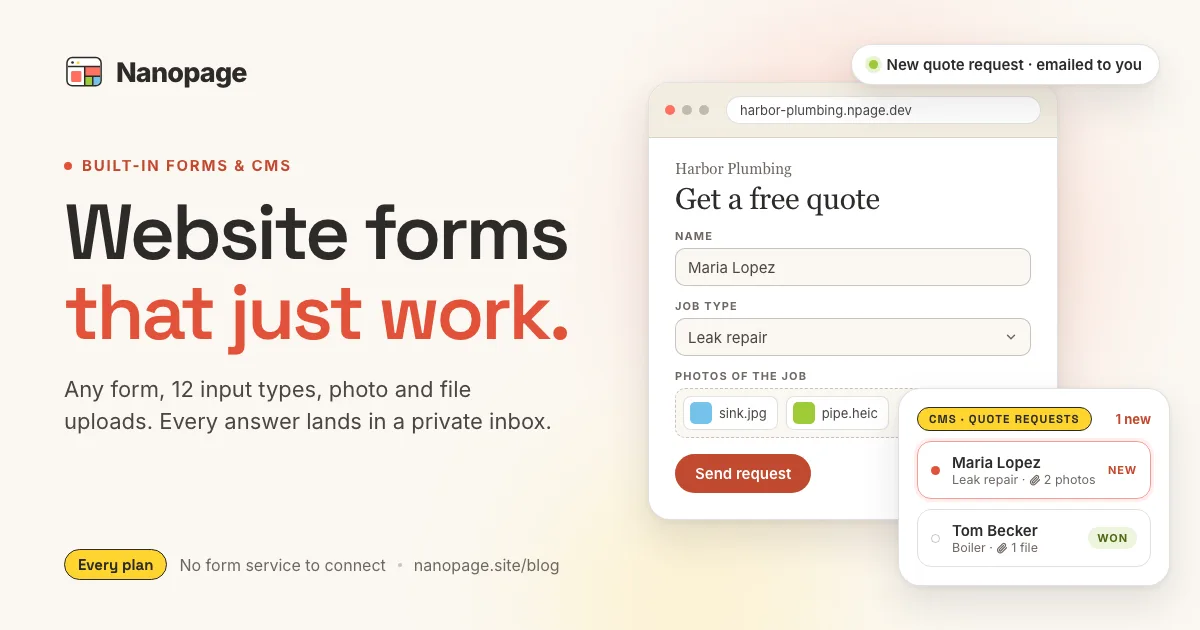
- Contact forms or booking links
- Basic SEO tags
- Updates after launch
None of those jobs disappear. They just stop requiring a person on retainer for a brochure site. The platform and the model do the mechanical work. You keep the decisions that only you can make: prices, hours, photos, tone, and the offer.
For a deeper look at that shift, see building a website is now a conversation.
What anyone can do today
If you can answer a few plain questions, you can have a site:
- What do you sell or offer?
- Who is it for, and where?
- What should the visitor do next — call, book, visit, email, RSVP?
- What proof do you have — photos, menu, resume, testimonials, listing details?
- What are the facts that must be correct — hours, address, prices, dates?
Write those down. Gather the files. Describe the page in ordinary language. Generate. Read it on your phone. Fix what is wrong. Publish.
That is the whole path. No discovery call. No wireframe review cycle. No "we'll get back to you next week."
For a structured brief, use the website brief template. For a same-day plan, use website in one day.
What still is not a commodity
Commodity access does not erase every reason to hire a specialist.
You still want a human team when you need:
- Custom software with accounts, workflows, and integrations
- Large e-commerce with inventory, tax, and fulfillment complexity
- Original brand systems, illustration, and multi-month identity work
- Deep integrations with proprietary internal tools
- Campaign sites that are really product launches, not business cards
A commodity website is the credible public page. It is not a replacement for building a product. Confusing those two is how people either overpay for a brochure or underbuild a real app.
Why this matters for small businesses
When websites were scarce, many good businesses stayed invisible. They relied on Instagram, a Google listing, word of mouth, and a phone number — and hoped that was enough.
When websites are abundant, the cost of *not* having one becomes the story. Customers still search. They still compare. They still want hours, proof, and a way to reach you without DMing a stranger. A clear page is table stakes, the way a working email address is table stakes.
Abundance also changes the economics. You no longer need to justify a four-figure build for a five-section page. You can launch, learn, and revise. The cost picture in 2026 looks nothing like the agency quote of 2016.
The new scarce skills
If the site itself is easy to get, what separates a useful page from a forgettable one?
- Clear facts, written without fluff
- Real photos instead of stock filler
- One primary call to action
- Mobile-first readability
- Willingness to update when reality changes
Those are business skills, not developer skills. The owner who knows the work is usually better at them than a stranger who heard the brief once.
What to do if you have been waiting
If you delayed a site because hiring felt expensive, slow, or intimidating, the constraint has moved.
This week you can:
- Write a one-page brief with the facts only you know.
- Collect photos, PDFs, prices, and contact details.
- Describe the site in plain language.
- Generate a hosted first version.
- Fix the obvious mistakes on your phone.
- Publish.
- Connect a custom domain when you are ready.
- Update later by just asking.
You do not need a developer for that path. You do not need an agency for that path. You need the truth about your business, written down.
The short version
Websites used to be projects. For most small businesses, they are becoming utilities.
Anyone who can describe what they do can have a real, hosted page right away. The specialist is optional for the common case. The brief is not.
Nanopage is built for that commodity moment: bring your files and your sentences, get a page, publish, and keep it current without opening a ticket. See how it works or check pricing when you are ready to stop waiting.