For years, choosing a content management system was partly a decision about who could rescue you later.
WordPress, Drupal, and other established platforms were safe choices for good reasons. They had large communities, extensive documentation, mature plugin ecosystems, and a deep pool of developers. If an agency disappeared, an employee left, or an old page broke, you could find someone else who understood the system.
That was not conservative thinking. It was sensible risk management.
But the risk model is changing.
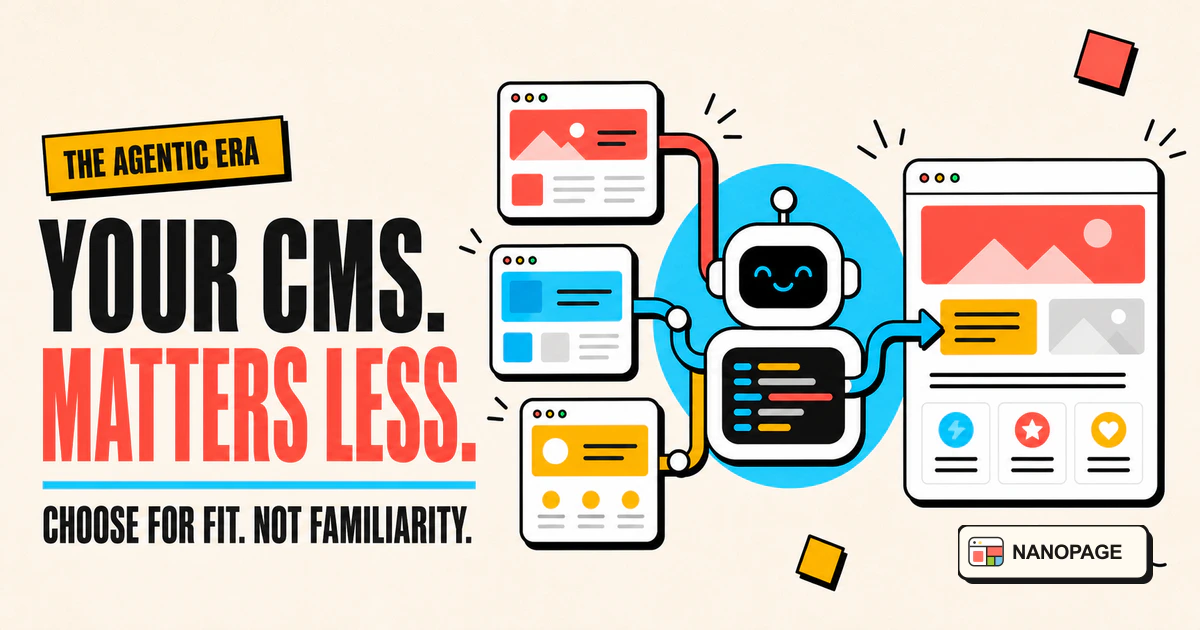
In the age of AI coding agents, your organization no longer depends as heavily on finding a person who already knows the exact CMS, theme system, plugin stack, or custom codebase. A capable agent can inspect an unfamiliar system, read its documentation, trace how content moves through it, make a scoped change, test the result, and explain what it did.
The underlying technology has not become irrelevant in an engineering sense. It has become far less important as a staffing constraint.
That distinction creates a new paradigm for choosing and maintaining website technology.
The old paradigm: choose the largest safety net
The traditional CMS decision often started with questions like these:
- How many developers know it?
- Will we be able to hire an agency for it in five years?
- Is there a plugin for every likely requirement?
- Can a new employee take over without learning a proprietary system?
- Is the platform popular enough that it will not disappear?
Those questions made sense because human expertise was expensive, unevenly distributed, and slow to acquire.
A good developer could learn a new system, of course. But the organization paid for that learning in discovery time, handover meetings, documentation work, and risk. Choosing a familiar CMS reduced the amount of context every new person needed before they could safely act.
Popularity therefore became a proxy for maintainability.
It was never the only measure of quality. It was a way to make sure the organization would not be stranded with a website nobody understood.
AI agents weaken the familiarity advantage
An AI coding agent approaches an unfamiliar CMS differently from a newly hired person.
It can search the codebase, compare configuration files, inspect the database schema, follow templates and routes, read API documentation, identify dependencies, and run tests in minutes. It does not need years of prior loyalty to a particular ecosystem before it can become useful.
That changes the value of familiarity.
The difference between a common platform and a less familiar one used to be substantial: one came with an available labor market, while the other came with onboarding costs and organizational dependence on a few specialists. With agentic coding, that gap gets much smaller.
An agent can work with:
- A mainstream open-source CMS
- A proprietary platform with a usable API
- A headless CMS connected to a custom frontend
- A static site with content stored in Markdown or structured files
- An internal publishing tool built for one organization's workflow
- A custom system that has never appeared in a job description
The agent still needs access and enough evidence to understand the system. But it does not need the technology to be popular before it can begin.
The interface is moving from software to intent
The deeper shift is not that AI agents know more CMSs. It is that the human interface is moving up a level.
In the old model, an editor learned the CMS interface and a developer learned the CMS internals. To change the website, someone had to translate a business request into the system's particular vocabulary: post types, blocks, modules, templates, fields, hooks, plugins, deployments.
In the agentic model, a person can start with intent:
"Add an author field to every article, show it below the title, and keep existing articles working when no author is present."
The agent translates that request into the local technology. On one website, it may update a WordPress custom post type. On another, it may change a Drupal content model. On a third, it may edit a schema, migration, API response, and frontend component.
The desired outcome stays the same. The implementation becomes the agent's problem.
That is why the CMS matters less to the person requesting the work. It becomes infrastructure behind an intent-based interface.
The new paradigm: choose for fit, not familiarity
If familiarity is no longer the main safety mechanism, organizations can choose website technology using more direct criteria.
Does it fit the publishing workflow? Does it keep the content structured and portable? Can it be operated securely? Does it expose enough of itself for an agent to inspect, change, and verify? Can the organization recover if a deployment goes wrong?
This opens up options that would previously have felt too risky.
A small organization may be better served by a simple static site and a lightweight content layer than by a general-purpose CMS with dozens of plugins. A specialized business may benefit from a custom content workflow instead of forcing its process into generic page-builder concepts. A product team may keep an unusual but effective internal system rather than funding a migration solely because hiring for it is difficult.
The question is no longer, "How many people already know this stack?"
It is, "Can a capable agent understand and operate this system safely?"
What still matters very much
This is not an argument for careless technology choices. AI can reduce the cost of understanding software. It cannot turn a badly governed system into a good one.
Some qualities become even more important in the new paradigm.
Access
An agent cannot maintain what it cannot inspect. Source code, configuration, documentation, APIs, schemas, logs, and safe development environments give the agent the context it needs. A completely opaque vendor system with no export path is still a lock-in risk, however intelligent the agent may be.
Portability
Your content should be exportable in a useful form. Clean HTML, Markdown, JSON, CSV, media files, and documented database schemas are better escape routes than a proprietary archive only one vendor can read.
Verification
The ability to make a change is not the same as the ability to prove it is correct. Version control, previews, automated tests, accessibility checks, deployment logs, and visual review make agentic work dependable.
Security and permissions
An agent should have only the access needed for the task. Publishing rights, customer data, secrets, plugins, and production infrastructure still require careful boundaries, audit trails, and human accountability.
Reversibility
Every important change should be easy to review and undo. Backups, content revisions, code history, staged deployments, and rollbacks matter regardless of whether the change was made by a person or an agent.
Technology matters. What changes is which properties deserve the most weight.
A better CMS checklist for the agentic era
When evaluating a CMS or website platform today, ask:
- Can we export our content and media in standard formats?
- Can an agent inspect the relevant code, schema, API, or documentation?
- Is there a safe preview or staging environment?
- Are changes versioned, reviewable, and reversible?
- Can permissions be limited by role and task?
- Are logs and errors available when something fails?
- Does the system fit our actual publishing workflow without excessive complexity?
- Can we move the site or rebuild its public output if the vendor disappears?
Community size and developer availability can still be useful signals. They are simply no longer the center of the decision.
What this means for existing websites
Organizations should not rush to replace working CMSs just because AI agents can handle something newer. A stable WordPress or Drupal installation may remain the right system. The point is not that established platforms lost their value.
The point is that "everyone knows it" is becoming a weaker reason to stay, migrate, or buy.
If your current system serves the publishing team, keeps content accessible, and operates safely, an agent can make it easier to maintain. If the system is slow, fragile, expensive, or badly matched to the work, the availability of agentic coding makes alternatives less intimidating.
It also changes how organizations should treat custom software. "Custom" used to imply permanent dependence on the original developer. That risk does not disappear, but it can be reduced dramatically when the system is inspectable, documented, versioned, and covered by tests. A future agent can reconstruct much of the missing context from the system itself.
The strategic asset is no longer CMS knowledge
In the old model, organizations accumulated platform-specific knowledge: who understood the theme, which plugin controlled the form, where the template was overridden, how deployments worked, and which contractor to call.
In the new model, the more durable assets are different:
- Clear ownership of content and outcomes
- Structured, portable data
- Documented business rules
- Secure access to systems
- Reliable tests and previews
- A record of decisions and changes
Those assets travel across technologies. They help an agent work with the system you have today and help you leave it tomorrow.
CMS becomes an implementation detail
For most organizations, the CMS was never the goal. Publishing accurate information, serving customers, explaining an offer, and keeping a website current were the goals.
The old paradigm forced organizations to think deeply about the tool because the supply of people who could operate that tool determined the long-term risk.
AI agents loosen that dependency. WordPress, Drupal, a proprietary platform, a headless system, or a custom content layer can all sit behind the same plain-language request. The agent learns the implementation so the organization can stay focused on the outcome.
This is already how Nanopage is designed to work. People can ask AI to shape the website, use the built-in CMS for structured day-to-day updates, or let an external coding agent publish through the Nanopage MCP server. The technology remains real, but it no longer has to be the user's job.
The safest choice is no longer automatically the CMS with the biggest labor pool.
It is the system that fits the work, keeps your information under control, and gives humans and agents a safe way to understand, change, verify, and move it.